.svg)
Go back
How Vanta Saves 2 Weeks with Magic Patterns
Magic Patterns lets me explore new ideas quickly and it actually looks like a Vanta feature.
Vanta helps over 16,000 companies manage compliance across dozens of frameworks and hundreds of integrations. That kind of product surface means the team is constantly shipping new workflows, from access reviews to vendor risk to trust reporting.
The Problem
Before Magic Patterns, the path from product idea to something engineers could build against took roughly two weeks. A PM would write a PRD, sketch a few ideas, then wait for design to turn those into mockups.
"With other prototyping tools, I’d upload a low-fidelity mockup and it would just be boxes and circles. I spent all my time trying to make it look like our actual product. Magic Patterns lets me explore new ideas quickly and it actually looks like a Vanta feature."
Erika Hairston, a Senior PM on the Personnel team, felt this gap acutely.
She tried using other AI prototyping tools to move faster. They were slow and produced generic outputs that didn’t resemble Vanta’s product. Instead of exploring new ideas, she was stuck trying to clean up what the tools generated.
Working Through Ideas Faster
Erika’s goal is simple. She wants to see what a workflow looks like while she is still thinking through the problem. With Magic Patterns, she can do that in seconds.
Magic Patterns focuses exclusively on frontend UI generation, a deliberate choice that resonated immediately with Erika. She can generate multiple versions of an idea in one sitting using the /Inspiration command, compare them, and refine her thinking before looping in her design partner for refinement.
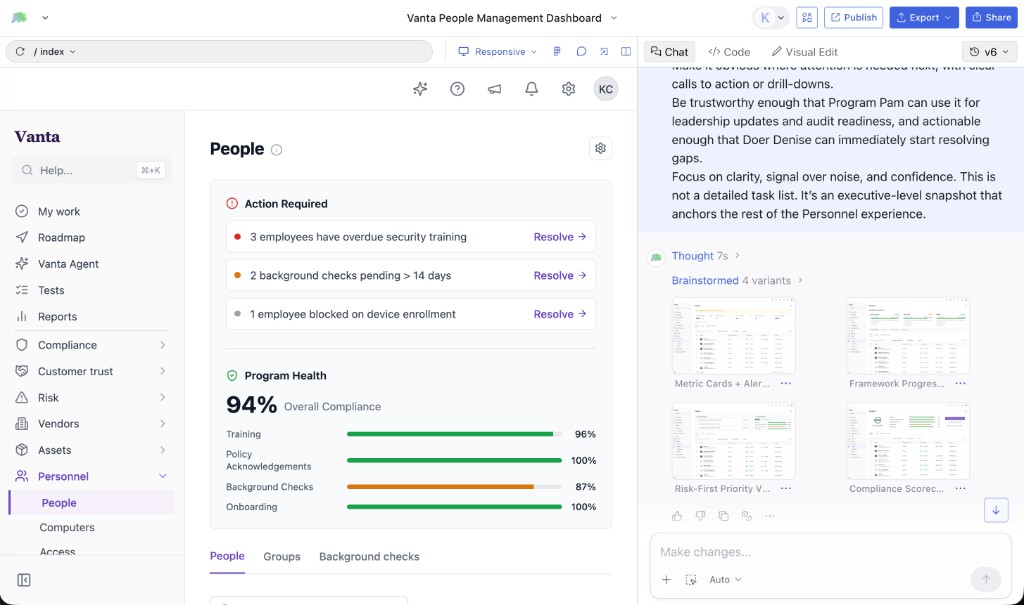
Vanta utilizing the /Inspiration command to brainstorm variants
By using screenshots of existing pages and building on Vanta’s design system, the prototypes come out polished and on-brand from the first pass.
PMs Bring Options, Not Ideas
When the team has an idea for a new feature, a PM writes a few sentences describing the problem and a rough solution, screenshots the page the feature will live on, and feeds both into Magic Patterns. The tool replicates the existing page using Vanta's components, then the PM uses natural language to generate multiple UX variations of the same problem and iterate.
What used to take two design rounds now happens in a single working session. A PM will spin up five or six variations on their own, share the top two or three with their design partner, and use that conversation to lock in interaction details and edge cases. Entire rounds of "is this what you meant?" meetings have dropped out of the process.
The designer no longer starts from scratch. By the time they get involved, the PM has already chosen a direction, so they can go straight into refinement.
Resolving Build Decisions in Hours, Not Weeks
When Erika's team was building a new AI-powered account detection feature, they hit a fundamental design question: should this be a chat interface embedded in an existing workflow or a standalone page?
Erika built both versions in Magic Patterns in about an hour.
She walked the team through each option in a single meeting. They chose the embedded workflow and moved straight into build. The feature shipped end-to-end in seven weeks.
Not Just the Personnel Team
Erika wasn't the only PM at Vanta who found this workflow transformative. Ojus Padston, a Staff Product Manager on a separate team, adopted Magic Patterns for a different but equally common challenge: early-stage idea exploration.
When Ojus is evaluating a new feature direction, like adding a risk scoring summary to Vanta's vendor management workflow, he doesn't start with a PRD or a meeting. He opens Magic Patterns, screenshots the existing vendor page, and starts generating variations. Within a few minutes he has three or four different takes on how the data could be surfaced: as an inline card, a sidebar panel, or a dedicated dashboard view. He shares the prototypes in Slack, and his team can react to something concrete before anyone has spent a full afternoon writing requirements.
"It does feel like genuine magic, being able to bring your ideas to life."
For Ojus, the biggest unlock is being able to think through a problem visually while the idea is still forming. Instead of describing a feature in a doc and hoping everyone pictures the same thing, he shows it. That pattern has spread across Vanta's product org. PMs on different teams now use Magic Patterns to explore ideas early, long before design or engineering resources are involved.
Impact
Engineering gets aligned earlier because the team converged on a visual artifact before a single line of code was written.
The compounding effect is that more feature directions get explored in the same calendar time. Where the team used to evaluate one approach over the course of two weeks, PMs now bring three or four to the table within a single afternoon. Engineering handoffs cover architecture and data, not pixel decisions that were never really settled.
Build the best version of your product.